UPDATE: 12:13 p.m.
MOSCOW/KYIV (Reuters) -The United States and NATO said Russia was still building up troops around Ukraine on Wednesday despite Moscow’s insistence it was pulling back, questioning President Vladimir Putin’s stated desire to negotiate a solution to the crisis.
In Ukraine, where people raised flags and played the national anthem to show unity against fears of an invasion, the government said a cyber attack that hit the defence ministry was the worst of its kind that the country had seen. It pointed the finger towards Russia, which denied involvement.
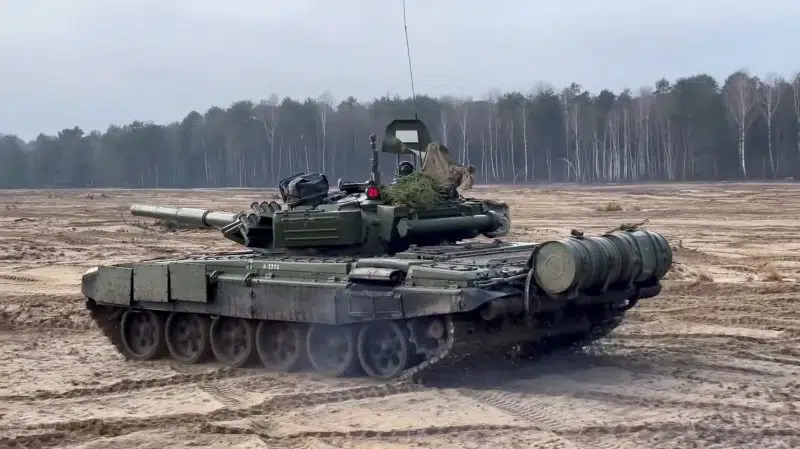
The Russian defence ministry said its forces were pulling back after exercises in southern and western military districts near Ukraine – part of a huge build-up that was accompanied by demands for sweeping security guarantees from the West.
It published video that it said showed tanks, infantry fighting vehicles and self-propelled artillery units leaving the Crimean peninsula, which Moscow seized from Ukraine in 2014.
But U.S. Secretary of State Antony Blinken said key Russian units were moving towards the border, not away.
“There’s what Russia says. And then there’s what Russia does. And we haven’t seen any pullback of its forces,” Blinken said in an interview on MSNBC. “We continue to see critical units moving toward the border, not away from the border.”
A senior Western intelligence official said the risk of Russian aggression against Ukraine would remain high for the rest of February and Russia could still attack Ukraine “with essentially no, or little-to-no, warning”.
NATO Secretary-General Jens Stoltenberg said moving troops and tanks back and forth did not amount to proof of a pullout.
“We have not seen any withdrawal of Russian forces. And of course, that contradicts the message of diplomatic efforts,” Stoltenberg said before a meeting of the alliance in Brussels. “What we see is that they have increased the number of troops and more troops are on their way. So, so far, no de-escalation.”
Stoltenberg later said NATO could prove Russia’s failure to pull back its troops with satellite images.
Ukraine‘s Defence Minister Oleksii Reznikov told Reuters in an interview his country’s latest intelligence report similarly showed no sign of a Russian pullback. He said the combined strength of Russian military and pro-Russian separatist forces near Ukraine‘s borders stood at about 140,000.
The Kremlin said NATO’s assessment was wrong. Moscow’s ambassador to Ireland said forces in western Russia would be back to their normal positions within three to four weeks.
INVESTORS WARY
World stocks edged lower on Wednesday while oil and gold rose as investors nervously responded to a lack of tangible evidence of Ukraine tensions being lowered.
Russia says it never planned to attack Ukraine but wants to lay down “red lines” to prevent its neighbor from joining NATO, which it sees as a threat to its own security.
The Kremlin said Putin was keen to negotiate with the United States, which has offered discussions on arms control and confidence-building measures while ruling out a veto on future NATO membership for Ukraine.
But Russia also said it would be ready to re-route energy exports to other markets if it was hit by sanctions, which Washington and its allies have threatened if it invades Ukraine.
Finance Minister Anton Siluanov said sanctions against Russian banks would be “unpleasant” but the state would ensure all deposits with banks and transactions were secured.
Russia has accused the United States of hysterical war propaganda after repeated warnings of a possible attack and reports in some Western media that it would happen on Wednesday.
U.S. President Joe Biden said on Tuesday that more than 150,000 Russian troops were still massed near Ukraine‘s borders and an invasion remained “distinctly possible”.
Military analysts say a significant pullback would involve field hospitals and fuel stores being dismantled and units from Russia’s far east, which are taking part in exercises in Belarus this week, returning to bases thousands of miles away.
Russia security specialist Mark Galeotti said the absence of an attack did not mean that “Putin blinked”.
“Putin could have invaded yesterday, he can still do so tomorrow,” he wrote on Twitter.
DAY OF UNITY
Ukrainian President Volodymyr Zelenskiy designated Wednesday a patriotic holiday in response to the reports Russia could invade on that day. “No one can love our home as we can. And only we, together, can protect our home,” he said.
The defence ministry said hackers were still bombarding its website and had found vulnerabilities but that traffic was being rerouted to servers in the United States while the issue was being fixed.
A senior Ukrainian security official said the only country interested in such cyber attacks was Russia. The Kremlin denied Russia was involved but said it was not surprised Ukraine would blame Moscow.
Kremlin spokesman Dmitry Peskov said Putin had “taken note” of a request from Russia’s parliament on Tuesday for him to recognise the “independence” of two breakaway regions in eastern Ukraine where Russian-backed separatists have been fighting Ukrainian government forces since 2014.
But he said that would not be line with agreements aimed at ending the conflict, in which Ukraine says some 15,000 people have been killed, indicating Putin would not rush to recognise the separatist areas but might keep the option in reserve.
Blinken said such a step would undermine Ukraine’s sovereignty, violate international law and “necessitate a swift and firm response from the United States in full coordination with our Allies and partners”.
(Reporting by Alexander Marrow and Alexander Vasovic; Additional reporting by Doina Chiacu and Susan Heavey in Washington, Phil Stewart and Sabine Siebold in Brussels; writing by Mark Trevelyan; editing by Philippa Fletcher, Gareth Jones and Grant McCool)
_______________
ORIGINAL STORY:
KYIV/MOSCOW/WASHINGTON (Reuters) – Kyiv appeared to blame Russia for a cyber attack on Tuesday as U.S. President Joe Biden warned that more than 150,000 Russian troops were still amassed near Ukraine‘s borders after Moscow’s announcement of a partial pullback was met with scepticism.
World powers are engaged in one of the deepest crises in East-West relations for decades, jostling over post-Cold War influence and energy supplies as Moscow wants to stop the former Soviet neighbour ever joining the NATO military alliance.
Western nations have suggested arms control and confidence-building steps to defuse the standoff, which has prompted them to urge their citizens to leave Ukraine because an attack could come at any time. Russia denies it has any plans to invade.
On Tuesday, the Russian defence ministry published footage to demonstrate it was returning some troops to base after exercises. Biden said the United States had not verified the move. “Our analysts indicate that they remain very much in a threatening position.”
Hours after Moscow’s announcement, Ukraine said the online networks of its defence ministry and two banks were overwhelmed in what is called a distributed denial-of-service. The manoeuvre works when hackers flood a network with unusually high volumes of data traffic to paralyse it.
Although Kyiv did not name who was behind the incident, a statement suggested it was pointing the finger at Russia.
“It is not ruled out that the aggressor used tactics of dirty little tricks because its aggressive plans are not working out on a large scale,” said the Ukrainian Centre for Strategic Communications and Information Security, which is part of the culture ministry.
Ukrainian bank Privatbank users reported problems with payments and a banking app, while Oshadbank said its systems had slowed down.
Russia’s Federal Security Service did not immediately reply to a request for comment from Reuters.
“If Russia attacks the United States or our allies through asymmetric means like disruptive cyber attacks against our companies or critical infrastructure, we’re prepared to respond,” Biden said in televised remarks from the White House.
One European diplomat said the hacking was concerning because a full military attack on Ukraine would likely be preceded by a cyber attack.
“It could mean a physical attack is imminent, or it could mean Russia is continuing to mess with Ukraine,” the diplomat said, on condition of anonymity. While such attacks are difficult to attribute, the diplomat said there was no doubt that Russia was behind them.
‘MEANINGFUL DE-ESCALATION’
The White House said energy prices could be hit if sanctions are imposed on Moscow following an invasion as diplomatic efforts continued on Tuesday to resolve the crisis.
Secretary of State Antony Blinken told Russian counterpart Sergei Lavrov on a call that there needed to be “verifiable, credible, meaningful de-escalation” by Moscow.
Biden and French President Emmanuel Macron discussed their readiness to hit Russia with “severe consequences” over the crisis.
NATO Secretary-General Jens Stoltenberg said there “are signs from Moscow that diplomacy should continue” but also that Russia often left military equipment behind after exercises, creating the potential for forces to regroup.
At a joint news conference with German Chancellor Olaf Scholz, Russian President Vladimir Putin referred only briefly to the troop moves.
Putin told reporters Russia would not be satisfied with talk that Ukraine was not ready to join NATO any time soon and was demanding that the issue be resolved now.
“As for war in Europe… about whether we want it or not? Of course not. That is why we put forward proposals for a negotiation process, the result of which should be an agreement on ensuring equal security for everyone, including our country,” he said.
Russia has been pressing for a set of security guarantees from the West and says it can exercise troops on its own territory as it sees fit.
Russia’s show of force near Ukraine‘s borders has prompted months of frantic Western diplomacy and drawn threats of severe sanctions if it invades.
The Kremlin sought to portray its moves as proof that Western talk of war had been both false and hysterical.
“February 15, 2022 will go down in history as the day Western war propaganda failed. Humiliated and destroyed without a single shot fired,” Foreign Ministry spokeswoman Maria Zakharova said.
The defence ministry published footage showing tanks and other armoured vehicles being loaded onto railway flatcars. Western military analysts said they needed more information to judge the significance of the latest troop movements.
Commercial satellite images taken on Sunday and Monday showed a flurry of Russian military activity at several locations near Ukraine.
Russian shares, government bonds and the rouble rose sharply on hopes the situation was easing, and Ukrainian government bonds rallied. Major stock indices rose in the United States and Europe.
Oil tumbled over 3%, retreating from a seven-year high.
“The situation is very fluid, but today is definitely a calmer day,” said Robert Yawger, executive director of energy futures at Mizuho. “It’s going to be a minute-to-minute, day-to-day type of thing.”
(Reporting by Maria Tsvetkova, Andrea Shalal and Dmitry Antonov; additional reporting by Reuters bureaux; writing by Mark Trevelyan and Costas Pitas; Editing by Angus MacSwan, Rosalba O’Brien and Grant McCool)



Comments