UPDATED 5:49 P.M.
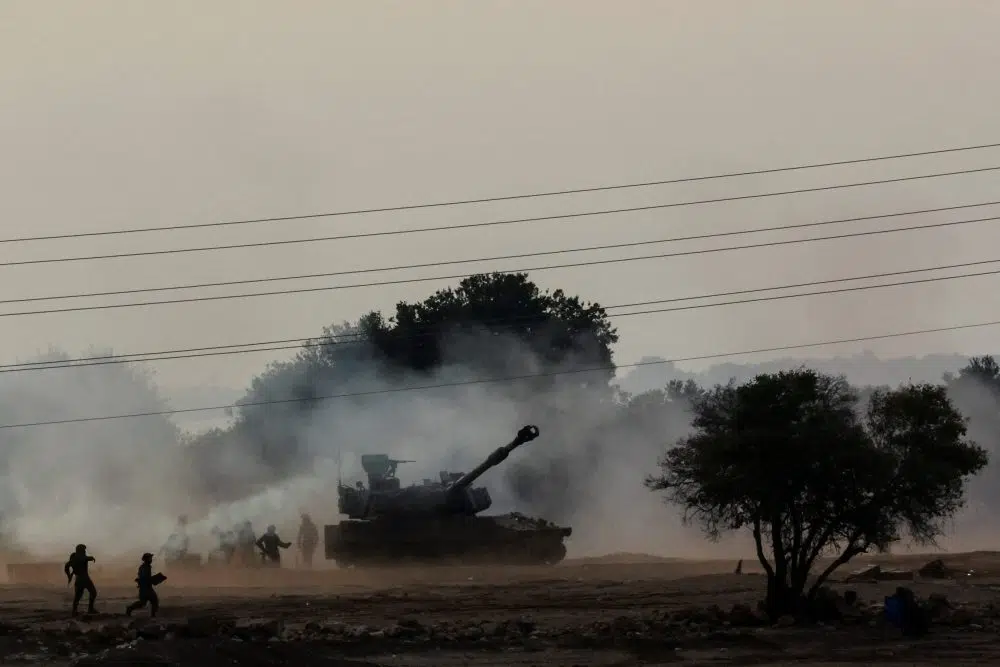
GAZA/JERUSALEM (Reuters) -The Israeli military said on Monday it had called up an unprecedented 300,000 reservists and was imposing a total blockade of the Gaza Strip, in a sign it may be planning a ground assault in response to the devastating weekend attack by Hamas gunmen.
After hours of intense bombardment by Israeli jets, Hamas, the Islamist movement that controls Gaza, said it would execute an Israeli captive for every Israeli bombing of a civilian house without warning.
Inside Israel, Palestinian fighters were still holed up in several locations, two days after they killed hundreds of Israelis and seized dozens of hostages in a raid that shattered Israel’s reputation of invincibility.
Israeli TV channels said the death toll from the Hamas attack had climbed to 900, with at least 2,600 injured. Gaza’s Health Ministry said at least 687 Palestinians had been killed and 3,726 wounded in Israeli air strikes on the blockaded enclave since Saturday.
The dead included citizens of Italy, Ukraine and the United States, where President Joe Biden announced on Monday that at least 11 Americans had been killed.
Hamas spokesman Abu Ubaida said the group had been acting in accordance with Islam by keeping the Israeli captives safe but issued the threat to kill civilians and broadcast it.
Echoing Hamas, the Islamic Jihad armed wing, which said it was holding more than 30 Israelis, asked Israel to refrain from hitting civilians if it cared about the fate of Israelis in its custody.
In Gaza, as Israel conducted intense retaliatory strikes, Defence Minister Yoav Gallant drew international condemnation by announcing a tightened blockade to prevent food and fuel from reaching the strip, home to 2.3 million people.
“Depriving the population in an occupied territory of food and electricity is collective punishment, which is a war crime,” Omar Shakir, Israel and Palestine Director at Human Rights Watch, said in a statement.
The Israeli air strikes became more aggressive as night fell, and witnesses said several Hamas security headquarters and ministries were hit. The strikes destroyed some roads and houses.
Israel also bombed the headquarters of the private Palestinian Telecommunication Co., which could affect landline telephone, internet and mobile phone services.
As it rained, explosions and lightning lit the skies, and the sound of bombings mixed with thunder.
In a further signal of Israel’s rapid shift to a war footing, a cabinet member from Prime Minister Benjamin Netanyahu’s Likud Party said it could set up a national unity government joined by opposition leaders within hours.
Netanyahu told mayors of southern towns hit by Saturday’s surprise assault that Israel’s response would “change the Middle East.”
At the Jabalia refugee camp in northern Gaza, men clambered onto a pancaked building to pull an infant’s tiny body from the rubble, carrying it down through the crowd below amid still-smoldering remains of bombed buildings.
That air strike killed and wounded dozens, according to the territory’s health ministry.
U.N. Secretary-General Antonio Guterres said some 137,000 people were taking shelter with UNRWA, the U.N. agency that provides essential services to Palestinians.
FIGHTING SPREAD
The prospect that fighting could spread to other areas alarmed the region. Israeli troops “killed a number of armed suspects that infiltrated into Israeli territory from Lebanese territory,” the military said, adding helicopters “are currently striking in the area.”
Lebanese armed group Hezbollah fired a salvo of rockets onto northern Israel on Monday in response to at least three of its members being killed in Israeli shelling on Lebanon.
In Israel’s south, scene of the Hamas attack, Israel’s chief military spokesman said troops had re-established control of communities inside Israel that had been overrun, but isolated clashes continued as some gunmen remained active.
The shocking images of the bodies of hundreds of Israelis sprawled across the streets of towns, gunned down at an outdoor dance party and abducted from their homes were like nothing seen before in the decades-old Israeli-Palestinian conflict.
The announcement that 300,000 reservists had been activated in just two days added to speculation that Israel could be contemplating a ground assault of Gaza, a territory it abandoned nearly two decades ago.
“We have never drafted so many reservists on such a scale,” chief military spokesperson Rear-Admiral Daniel Hagari said. “We are going on the offensive.”
Palestinians reported receiving calls and mobile phone audio messages from Israeli security officers telling them to leave areas mainly in the northern and eastern territories of Gaza, and warning that the army would operate there.
Hamas, which calls for Israel’s destruction, says its attack was justified by the plight of Gaza under a 16-year-old blockade and the deadliest Israeli crackdown for years in the occupied West Bank.
‘A TOTAL MASSACRE’
Mainstream Palestinian groups who deplored the attacks said the violence was nonetheless predictable, with a peace process frozen for nearly a decade and far-right Israeli leaders talking of annexing Palestinian land once and for all.
Israel and Western countries said nothing justified the intentional mass killing of civilians.
The attackers gunned down scores of young Israelis at the desert dance party – media reported 260 killed there. A day later dozens of survivors were still emerging from hiding. The site was littered with wrecked and abandoned cars.
“It was just a massacre, a total massacre,” said Arik Nani, who had been celebrating his 26th birthday and escaped by hiding for hours in a field.
In Gaza, footage obtained by Reuters showed dozens of people climbing over collapsed buildings in search of survivors, the air still dusty from impact. Sirens rang out as emergency teams put out cars that had caught fire.
Egypt, which has mediated between Israel and Hamas in the past, was in close contact with the two sides, according to Egyptian security sources. Turkish President Tayyip Erdogan also said his country was ready for a mediator role.
Qatari mediators have held urgent calls with Hamas officials to try to negotiate freedom for Israeli women and children seized by the militant group and held in Gaza, in exchange for the release of 36 Palestinian women and children from Israel’s prisons, a source told Reuters.
An Israeli official said no negotiations were under way.
The violence jeopardises U.S.-backed moves towards normalising relations between Israel and Saudi Arabia – a security realignment that could have threatened Palestinian hopes of self-determination and hemmed in Hamas backer Iran.
Israel’s military faces harsh questions about the country’s worst intelligence failure in 50 years. Netanyahu’s options may also be curtailed by concern over the fate of Israeli hostages.
(Reporting by Maayan Lubell and Ari Rabinovitch in Jerusalem, Nidal al-Mughrabi in Gaza and Ammar Anwar in Sderot; Additional reporting by Henriette Chacar, Emily Rose and Dan Williams in Jerusalem, Ali Sawafta in Ramallah and Steven Scheer in Modiin, and Washington bureau; Writing by Michael Georgy, Nick Macfie and Patricia Zengerle; Editing by Peter Graff, Rosalba O’Brien, Cynthia Osterman and Howard Goller)
—————————————–
GAZA/JERUSALEM (Reuters) -The Israeli military said it had called up an unprecedented 300,000 reservists and was imposing a total blockade of the Gaza Strip, in a sign it may be planning a ground assault in response to the devastating weekend attack by Hamas gunmen.
After hours of intense bombardment by Israeli jets, Hamas, the Islamist movement which controls Gaza, said it would execute an Israeli captive if civilian houses were bombed.
Inside Israel, Palestinian fighters were still holed up in several locations, two days after they killed hundreds of Israelis and seized dozens of hostages in a raid that shattered Israel’s reputation of invincibility.
Israeli TV channels said the death toll from the Hamas attack had climbed to 900.
Hamas spokesman Abu Ubaida said the group had been acting in accordance with Islam by keeping the Israeli captives safe.
But in return for every Israeli bombing of a civilian house without warning, it will begin executing an Israeli civilian captive and broadcast it, he said.
In Gaza, Israel pressed on with its most intensive retaliatory strikes ever, which have killed more than 500 people since Saturday. Defence Minister Yoav Gallant announced a tightened blockade, which would prevent even food and fuel from reaching the strip, home to 2.3 million people.
As night fell, the Israeli air strikes became more aggressive and witnesses said several Hamas security headquarters and ministries were hit. The strikes also destroyed some roads and houses.
Israel also bombed the headquarters of the private Palestinian Telecommunication Co., which could impact land phone, internet and mobile phone services.
As it rained, explosions and lightning lit the skies as thunder mixed with the sound of the bombings.
In a further signal of Israel’s rapid shift to a war footing, a cabinet member from Prime Minister Benjamin Netanyahu’s Likud Party said it could set up a national unity government joined by opposition leaders within hours.
Netanyahu told mayors of southern towns hit by Saturday’s surprise assault that Israel’s response would “change the Middle East”.
At the Jabalia refugee camp in northern Gaza, men clambered on a pancaked building to pull an infant’s tiny body from the rubble, carrying it down through the crowd below amid still-smouldering remains of bombed buildings.
That air strike killed and wounded dozens, according to the territory’s health ministry.
U.N. Secretary-General Antonio Guterres said some 137,000 people were taking shelter with UNRWA, the U.N. agency that provides essential services to Palestinians.
FIGHTING SPREAD
The prospect that fighting could spread to other areas has alarmed the region. Israeli troops “killed a number of armed suspects that infiltrated into Israeli territory from Lebanese territory”, the military said, adding helicopters “are currently striking in the area”.
An official with Hezbollah denied that the group had mounted any operation into Israel. Hezbollah, a Shi’ite militant group powerful in southern Lebanon, is, like Hamas, backed by Iran.
Artillery shelling and gunfire were heard at Lebanon’s southern border with Israel, a correspondent for Hezbollah’s Al-Manar TV said in a post on social media. Israel’s Army Radio gave the location as being near Adamit, across from the Lebanese border towns of Aalma El Chaeb and Zahajra.
The Al Quds Brigades, the armed wing of the Palestinian Islamic Jihad movement, claimed responsibility for an attack at the Lebanon-Israel border.
In Israel’s south, scene of the deadly Hamas attack, Israel’s chief military spokesman said troops had re-established control of communities inside Israel that had been overrun, but that isolated clashes continued as some gunmen remained active.
The shocking images of the bodies of hundreds of Israeli civilians sprawled across the streets of towns, gunned down at an outdoor dance party and abducted from their homes were like nothing seen before in the decades-old Israeli-Palestinian conflict.
The announcement that 300,000 reservists had been activated in just two days added to speculation that Israel could be contemplating a ground assault of Gaza, a territory it abandoned nearly two decades ago.
“We have never drafted so many reservists on such a scale,” chief military spokesperson Rear-Admiral Daniel Hagari said. “We are going on the offensive.”
Palestinians reported receiving calls and mobile phone audio messages from Israeli security officers telling them to leave areas mainly in the northern and eastern territories of Gaza, and warning that the army would operate there.
Hamas, which calls for Israel’s destruction, says its attack was justified by the plight of Gaza under a 16-year blockade and the deadliest Israeli crackdown for years in the occupied West Bank.
‘A TOTAL MASSACRE’
Mainstream Palestinian groups who deplored the attacks said the violence was nonetheless predictable, with a peace process frozen for nearly a decade and far-right Israeli leaders talking of annexing Palestinian land once and for all.
Israel and Western countries said nothing justified the intentional mass killing of civilians.
The attackers gunned down scores of young Israelis at the desert dance party – media reported 260 killed there. A day later dozens of survivors were still emerging from hiding. The site was littered with wrecked and abandoned cars.
“It was just a massacre, a total massacre,” said Arik Nani, who had been celebrating his 26th birthday and escaped by hiding for hours in a field.
In Gaza, footage obtained by Reuters showed dozens of people climbing over collapsed buildings in search of survivors, the air still dusty from impact. Sirens rang out as emergency teams put out cars that had caught fire.
At least 560 Palestinians have been killed and 2,900 wounded in Israeli air strikes on the blockaded enclave since Saturday, said Gaza’s Health Ministry.
“The Zionist enemy’s military targeting and bombing of homes inhabited by women and children, mosques and schools in Gaza amount to war crimes and terrorism,” Hamas official Izzat Reshiq said in a statement.
Egypt, which has mediated between Israel and Hamas at times of conflict in the past, was in close contact with the two sides, according to Egyptian security sources.
Qatari mediators have held urgent calls with Hamas officials to try to negotiate freedom for Israeli women and children seized by the militant group and held in Gaza, in exchange for the release of 36 Palestinian women and children from Israel’s prisons, a source told Reuters.
An Israeli official said no negotiations were under way.
The violence jeopardises U.S.-backed moves towards normalising relations between Israel and Saudi Arabia – a security realignment that could have threatened Palestinian hopes of self-determination and hemmed in Hamas backer Iran.
“The price the Gaza Strip will pay will be a very heavy one that will change reality for generations,” Defence Minister Gallant said in Ofakim, one of the towns that had been attacked.
Israel’s military faces harsh questions for the country’s worst intelligence failure in 50 years. Netanyahu’s options may also be curtailed by concern over the fate of Israeli hostages.
(Reporting by Maayan Lubell and Ari Rabinovitch in Jerusalem, Nidal al-Mughrabi in Gaza and Ammar Anwar in Sderot; Additional reporting by Henriette Chacar, Emily Rose and Dan Williams in Jerusalem, Ali Sawafta in Ramallah and Steven Scheer in Modiin, and Washington bureau; Writing by Michael Georgy and Nick Macfie; Editing by Peter Graff and Rosalba O’Brien)
————————-
JERUSALEM/GAZA (Reuters) -Israel’s troops were battling on Monday to clear out Hamas gunmen more than two days after they burst across the fence from Gaza on a deadly rampage, and the army said it would soon go on the offensive after the biggest mobilization in Israeli history.
Fighters were still holed up in several locations inside Israel after killing 700 Israelis and seizing dozens of hostages in a raid that shattered Israel’s reputation of invincibility.
In Hamas-controlled Gaza, Israel carried out its most intensive retaliatory strikes ever, killing some 500 people since Saturday. Defense Minister Yoav Gallant said Israel’s blockade would be tightened to prevent food and fuel from being brought into the strip, home to 2.3 million people.
Israel’s chief military spokesman said troops had re-established control of communities that had been overrun, but that isolated clashes continued as some Palestinian gunmen remained active.
“We are now carrying out searches in all of the communities and clearing the area,” chief military spokesperson Rear-Admiral Daniel Hagari said.
Earlier, another spokesman, Lieutenant Colonel Richard Hecht, acknowledged that it was “taking more time than we expected to get things back into a defensive, security posture”.
The shocking images of the bodies of hundreds of Israeli civilians sprawled across the streets of towns, gunned down at an outdoor dance party and abducted from their homes were like nothing seen before in the decades-old Israeli-Palestinian conflict.
Hagari said 300,000 reservists had already been activated in just two days, adding to speculation that Israel could be contemplating an unprecedented ground assault of Gaza, a territory it abandoned nearly two decades ago.
“We have never drafted so many reservists on such a scale,” Hagari said. “We are going on the offensive.”
Palestinians reported receiving calls and mobile phone audio messages from Israeli security officers telling them to leave areas mainly in the northern and eastern territories of Gaza, and warning that the army would operate there.
Hamas says the attack was justified by the plight of Gaza under a 16-year blockade and the deadliest Israeli crackdown for years in the occupied West Bank. Mainstream Palestinian groups who deplored the attacks said violence was predictable with a peace process frozen for nearly a decade and far-right Israeli leaders talking of annexing Palestinian land once and for all.
Israel and Western countries said nothing justified the intentional mass killing of civilians.
The attackers gunned down scores of young Israelis – media reported as many as 260 killed – at an outdoor desert dance party. A day later dozens of survivors were still emerging from hiding. The site was littered with wrecked and abandoned cars.
“It was just a massacre, a total massacre,” said Arik Nani, who had been celebrating his 26th birthday and escaped by hiding for hours in a field.
Israel’s retaliation was also on a scale unseen despite four wars in Gaza since Hamas took control there 16 years ago. In footage obtained by Reuters, dozens of people were seen climbing over collapsed buildings in search of survivors, the air still dusty from impact. Sirens rang out as emergency teams put out cars that had caught fire.
“The man you see is one martyr of dozens. This place is packed with residents and people who were displaced,” a man said in the video as people pulled a body from the rubble.
EGYPTIAN MEDIATION?
Egypt, which has mediated between Israel and Hamas at times of conflict in the past, was in close contact with the two sides, trying to prevent further escalation, according to Egyptian security sources.
The violence jeopardizes U.S.-backed moves towards normalizing relations between Israel and Saudi Arabia – a security realignment that could have threatened Palestinian hopes of self determination and hemmed in Hamas’s backer Iran.
Hamas fighters were continuing to cross into Israel from Gaza, the military said, adding that between 70 and 100 gunmen have been killed in the Beeri area since Saturday.
Fighter jets, helicopters and artillery struck over 500 Hamas and Islamic Jihad targets in the Gaza Strip overnight, with targets including Hamas and Islamic Jihad command centres and the residence of a senior Hamas official, Ruhi Mashtaa.
“The price the Gaza Strip will pay will be a very heavy one that will change reality for generations,” Defense Minister Gallant said in Ofakim, one of the towns where calm was restored after a battle with Hamas fighters.
Prime Minister Benjamin Netanyahu’s options for hitting Hamas, which controls the narrow Gaza Strip that is home to 2.3 million Palestinians, could be curtailed by concern for the many Israelis seized in the raid. A full-scale invasion of Gaza, which Netanyahu has tried to avoid in his long years in power, could endanger the lives of the hostages.
In a statement, the Israeli Air Force said it dropped some 2,000 munitions and more than 1,000 ton bombs on Gaza aimed at over 8,000 targets in Gaza in the last 20 hours. Among the targets were three rocket launchers directed at Israel, a mosque where militants were operating and 21 high-rise buildings that served militant activity.
Since Saturday, at least 493 people were killed and more than 2,750 people were wounded, said the Health Ministry in Gaza.
“The Zionist enemy’s military targeting and bombing of homes inhabited by women and children, mosques and schools in Gaza amount to war crimes and terrorism,” Hamas official Izzat Reshiq said in a statement.
Hamas’s main international ally Iran congratulated Hamas on the attack, while denying involvement. Israeli forces and Lebanon’s Iran-backed Hezbollah militia exchanged artillery and rocket fire.
Appeals for restraint came from around the world, though Western nations largely stood by Israel.
CAPTIVES
Israel’s military, which faces harsh questions for the country’s worst intelligence failure in 50 years, said it had regained control of most infiltration points along security barriers, killed hundreds of attackers and captured dozens more.
Tens of thousands of soldiers are now around Gaza and the military is evacuating Israelis around the frontier.
Israel has not released an official toll but its media said at least 700 people were killed in Saturday’s attacks, children among them. Military spokesperson Daniel Hagari called it “the worst massacre of innocent civilians in Israel’s history.” Netanyahu has vowed revenge.
Palestinian fighters took dozens of hostages to Gaza, including soldiers and civilians, children and the elderly. A second Palestinian militant group, Islamic Jihad, said it was holding more than 30 of the captives.
“The cruel reality is Hamas took hostages as an insurance policy against Israeli retaliatory action, particularly a massive ground attack and to trade for Palestinian prisoners,” said Aaron David Miller, a senior fellow at the Carnegie Endowment for International Peace.
(Reporting by Maayan Lubell and Ari Rabinovitch in Jerusalem, Nidal al-Mughrabi in Gaza and Ammar Anwar in Sderot; Additional reporting by Henriette Chacar, Emily Rose and Dan Williams in Jerusalem, Ali Sawafta in Ramallah and Steven Scheer in Modiin, and Washington bureau; Writing by Michael Georgy; Editing by Peter Graff)




Comments