UPDATED: 11:40 a.m.
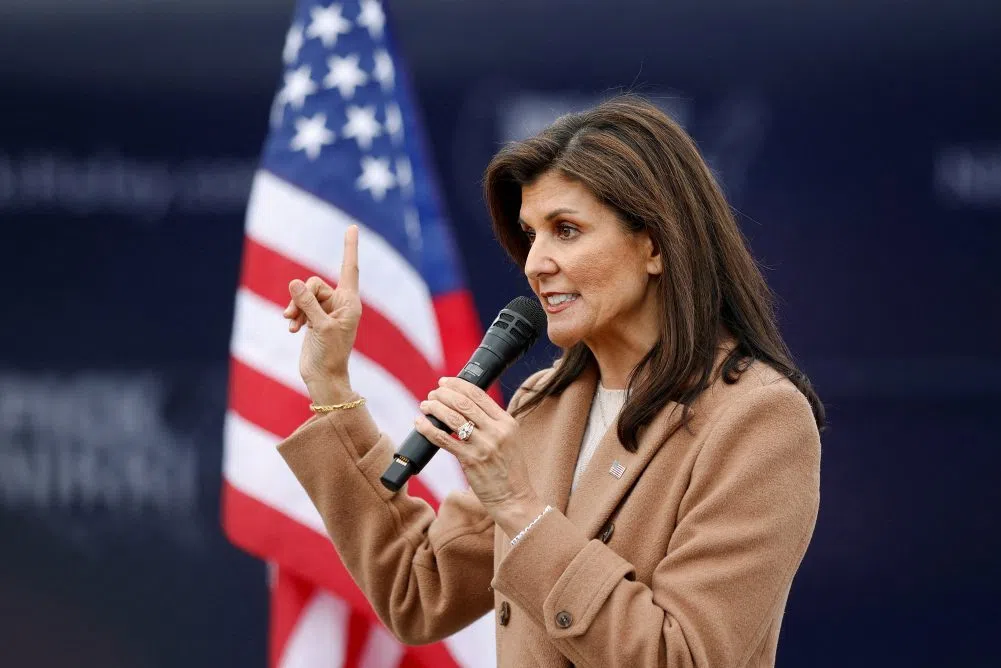
GREENVILLE, South Carolina (Reuters) – Republican candidate Nikki Haley pledged to press ahead with her long-shot presidential bid on Tuesday, saying “we don’t anoint kings in this country” and that she had no intention of dropping out after Saturday’s nominating contest in South Carolina.
“I feel no need to kiss the ring. And I have no fear of Trump’s retribution,” she said in a speech in Greenville, South Carolina, where she is expected to lose to former President Donald Trump in this weekend’s primary in her home state.
Trump, who has an overwhelming lead in national polls, and his allies have ratcheted up pressure on Haley to drop out of the race after she lost the first four nominating contests by huge margins. Her insistence on continuing her White House bid has angered Trump’s campaign, which has mocked her and threatened to cut off donors who continue to give her money.
“We don’t anoint kings in this country. We have elections,” Haley said in her speech. “That’s why I refuse to quit. South Carolina will vote on Saturday. But on Sunday, I’ll still be running for president. I’m not going anywhere.”
Haley, who served as governor of South Carolina from 2011 to 2017, is down some 60 points to Trump nationally, according to an average maintained by polling and analysis website FiveThirtyEight. Earlier on Tuesday, Trump’s campaign released a memo arguing that the former president was on track to mathematically clinch the nomination by March 12 based on current data.
While Haley indicated earlier in the race that she thought she could beat Trump in her home state, polls have consistently shown her down more than 30 percentage points there.
As a result, deep-pocketed allies have begun to turn their attention to several states and territories that vote in early March, some of which have a high proportion of well-educated suburbanites. That demographic made up Haley’s core base of support in the opening primary contests.
Haley’s campaign itself has rolled out leadership teams in at least seven states that vote on March 5 – a date known as “Super Tuesday” – as well as a leadership team in Georgia, where voters go to the polls on March 12. Two of those teams, in Texas and Vermont, were announced on Tuesday.
(Reporting by Gram Slattery, editing by Ross Colvin and Bill Berkrot)
ROCK HILL, South Carolina (Reuters) – Backers of Nikki Haley’s quest for the Republican presidential nomination are pouring money into states that hold early March nominating contests in a bid to keep her candidacy alive, regulatory filings and pro-Haley political operatives said.
Those efforts have ramped up in recent days and reflect a growing belief that Haley will not pull off an upset win in her home state of South Carolina, where former President Donald Trump holds a deep well of support.
The former governor has been crisscrossing the state ahead of its Saturday primary but has largely failed to chip away at Trump’s lead in opinion polls of more than 30 points.
Six analysts and people supporting Haley’s nomination now say the former U.S. ambassador to the United Nations will have her best – and last – shot to claw back into the race during the first five days of March.
That’s when voters from 21 states and territories go to polls, most of them on March 5 for “Super Tuesday.” Many of those states, like Massachusetts and Virginia, are laced with college-educated suburbanites who turned out for Haley in earlier nominating contests elsewhere.
“South Carolina is a really rough state. It’s a very Trump-friendly state,” said Robert Schwartz, the co-founder of Primary Pivot, an outside super PAC supporting Haley’s bid.
“Our hope is that Nikki Haley can make it respectable in South Carolina and move on to Super Tuesday.”
The long-shot bet on early March underscores how some donors are willing to stick by her, even though she lost the first four nominating contests by huge margins. Around a dozen donors, fundraisers and advisers to donors told Reuters they believe Trump’s four pending criminal cases could force him out, leaving Haley the heir apparent, while others simply like having an anti-Trump candidate.
Primary Pivot, which has raised about $1 million from big- and small-dollar donors, is targeting independent voters and Democrats who opt to vote in Republican primaries. Schwartz said the group has sent text messages promoting Haley to voters in Maine, Massachusetts, Colorado and Virginia — all Super Tuesday states.
The group recently hired advisers in Michigan and Virginia and is looking to recruit staff in Massachusetts and Minnesota, Schwartz added.
Many of those states are seen likely to vote for Democratic President Joe Biden in the Nov. 5 election, and primary victories there may do little to help Haley win the support of Republican voters elsewhere in the country.
Americans for Prosperity Action, a super PAC supporting Haley backed by conservative billionaire Charles Koch, has also ramped up its activity in states that vote in March, according to filings submitted to the Federal Election Commission.
After a lull throughout most of February, the group disclosed on Friday it spent $100,000 for campaign workers to go house to house for conversations with voters in Tennessee and North Carolina, as well as $75,000 for more door-knocking in Virginia.
Stand for America, another pro-Haley super PAC, has focused its spending on South Carolina. But it put a little over $2,000 towards anti-Trump text messaging in Texas last week, disclosures showed, and it is studying a move into Super Tuesday states, a person with knowledge of the group’s activities said.
‘ONLY STRATEGY SHE’S GOT’
Even Haley’s supporters concede her chances of pulling off an upset in the Republican nomination battle are exceedingly remote.
“I think it’s the only strategy she’s got,” Chip Felkel, a veteran South Carolina Republican operative, said of the decision to focus on March’s nominating contests. “She’ll lose South Carolina by a considerable margin.”
While state-level polling is inconsistent, no poll has shown Haley ahead in any state.
Trump’s campaign is confident it can wrap up the nomination by March 19, based on a mix of public and proprietary polling, a senior campaign official said.
Senior Trump adviser Jason Miller on Sunday shared a series of poll results on the social media site X showing Haley well behind in eight Super Tuesday states.
About half of all delegates, who in turn select a nominee at the party’s national convention in July, will have been awarded by the end of Super Tuesday. That means Haley needs to perform credibly in early March, or she will come perilously close to being mathematically eliminated from the contest.
Haley herself said in late January she needed to do better in South Carolina than she did in New Hampshire, where she lost to Trump by roughly 11 points. She has avoided commenting on concrete goals since.
Haley has already campaigned in California and Texas, both Super Tuesday states, and her campaign has rolled out leadership teams in at least five states – Alaska, Massachusetts, Idaho, Utah and Washington – that vote in early March.
Matthew Ingham, a 38-year-old truck driver at a Haley event in Sumter on Monday, said he does not think Haley needs to win in South Carolina. But that she needed a “strong push” to win some of the contests down the line, adding, “She can’t keep coming in second.”
(Reporting by Gram Slattery in Rock Hill, South Carolina, additional reporting by Nathan Layne in Sumter, South Carolina; Editing by Scott Malone and Cynthia Osterman)



Comments