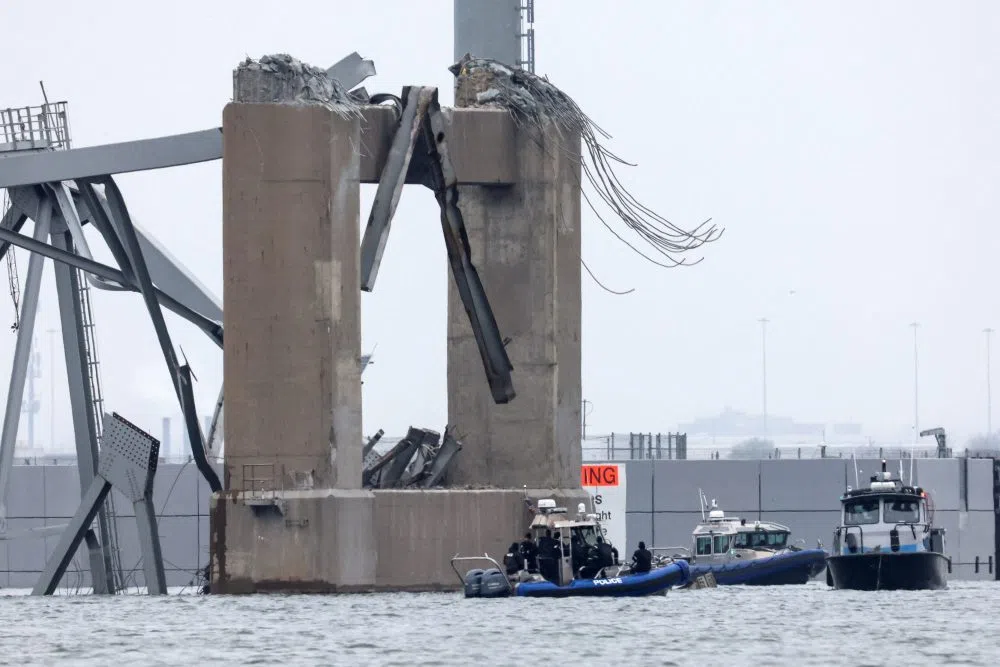
UPDATE 5:26 P.M.
BALTIMORE (Reuters) -Divers recovered the remains on Wednesday of two of the six missing workers tossed into Baltimore Harbor from a highway bridge that collapsed into shipping lanes after being rammed by a faltering cargo freighter, officials said.
The bodies were pulled from the Patapsco River a day after the massive container ship lost power and its ability to maneuver before plowing into a support pylon of the Francis Scott Key Bridge, knocking most it into the water below.
A Maryland State Police official said the truck containing the bodies of the two men was found in about 25 feet of water near the mid-section of the fallen bridge. He also said that further efforts to recover remains were being suspended because of the increasingly treacherous conditions.
Four more workers who were part of a crew filling potholes on the bridge’s road surface at the time remained missing and were declared on Tuesday night to be presumed dead, 18 hours after the crash.
Collapse of the bridge, a major highway artery across the harbor, forced an indefinite closure of the Port of Baltimore, one of the busiest on the U.S. Eastern Seaboard, handling more automobile and farm equipment freight.
Earlier in the day, federal investigators examined the cargo ship while emergency teams searched for bodies and details emerged of the intense efforts to save lives in the minutes before the steel span collapsed.
“Hold all traffic on the Key Bridge. There’s a ship approaching that just lost their steering,” someone said on police radio minutes before the 1:30 a.m. crash on Tuesday.
While voices were heard discussing next steps, including alerting any work crews to leave the bridge, one broke through to say: “The whole bridge just fell down!” The audio was carried by Broadcastify, an open-source audio streaming service.
The recording offered a glimpse of how authorities scrambled before the crash sent six bridge repair workers on the night shift to their deaths in the frigid black waters.
The Singapore-flagged Dali, a container ship the length of three football fields, had reported a loss of power before impact and dropped anchor to slow the vessel, giving authorities barely enough time to halt traffic on the bridge and likely prevent greater loss of life.
The disaster closed the Port of Baltimore and created a traffic quagmire for Baltimore and the densely populated region.
The bridge collapse could cost insurers billions of dollars in claims, analysts said, with one putting the cost at as much as $4 billion, which would make the tragedy a record shipping insurance loss.
Investigators from the U.S. National Transportation Safety Board recovered the data recorder after boarding the ship late on Tuesday and returned to the vessel on Wednesday to interview the ship’s crew, other survivors and emergency responders, NTSB Chair Jennifer Homendy said.
Rescuers pulled two workers from the water alive on Tuesday, and one was hospitalized. The six presumed dead included immigrants from Mexico, Honduras, Guatemala and El Salvador, officials said.
FOCUS ON OPENING PORT, CAUSE OF CRASH
The U.S. Coast Guard priorities are to restore the waterway for shipping, stabilize the vessel and extricate it, Vice Admiral Peter Gautier said at a White House news briefing.
“The real critical thing here is that, as you know, a portion of the bridge remains on the bow on that ship,” he said. The Coast Guard would work with the U.S. Army Corps of Engineers to remove the debris before the vessel is moved, he said.
The wreck drew attention to the vessel’s safety record, but Gautier said, the ship had a “fairly good safety record.”
Of the ship’s 4,700 cargo containers, 56 hold hazardous materials but there is no threat to the public, he said. Two containers went overboard during the crash but they did not contain hazardous materials.
The ship is carrying more than 1.5 million gallons of fuel oil, he added.
Data from the ship will provide investigators with a timeline of what happened, the NTSB’s Homendy told reporters as she prepared to board the vessel. The NTSB scheduled a briefing for Wednesday evening.
The process will involve taking photos of the ship and the 47-year-old bridge and getting electronic logs. The agency will also examine whether contaminated fuel played a role in the ship’s power loss, she said.
The Port of Baltimore handles more automobile freight than any other U.S. port – more than 750,000 vehicles in 2022, according to port data, as well as container and bulk cargo ranging from sugar to coal.
Still, economists and logistics experts said they doubted the port closure would unleash a major U.S. supply chain crisis or major spike in the price of goods, due to ample capacity at rival shipping hubs along the Eastern Seaboard.
The loss of the bridge also snarled roadways across Baltimore, forcing drivers onto two other congested harbor crossings and complicating daily commutes and regional traffic detours for months or even years to come.
(Reporting by Gabriella Borter in Baltimore; Additional reporting by Rami Ayyub, Nandita Bose, Doina Chiacu, Ted Hesson, Katharine Jackson, Mike Segar, David Shephardson; Writing by Doina Chiacu and Steve Gorman; Editing by Howard Goller)
——————————————-
WASHINGTON (Reuters) -The catastrophic bridge collapse that closed the Port of Baltimore to ship traffic on Tuesday is causing some logistics headaches, but is unlikely to trigger a major new U.S. supply chain crisis as competing East Coast ports are poised to handle more cargo, economists and logistics experts say.
With six people presumed dead after a container ship collision destroyed the Francis Scott Key Bridge, it remained unclear how long the span’s twisted superstructure would block the harbor’s mouth.
But port officials from New York to Georgia were busy fielding queries from shippers about diverting Baltimore-bound cargo from containers to vehicles and bulk material.
“We’re ready to help. We have ample capacity to absorb any surge in container traffic,” Port of Virginia spokesperson Joe Harris told Reuters.
The Norfolk-based port is expected to be a major beneficiary due to its proximity to Baltimore, but ports in Savannah and Brunswick, Georgia, also were poised to absorb some traffic, a spokesperson for the Georgia Ports Authority said.
U.S. Transportation Secretary Pete Buttigieg told MSNBC on Wednesday that while there were many ports on the East Coast, “there is no substitute for the Port of Baltimore being up and running,” as it is the top U.S. port for vehicle imports and exports, including farm and construction machinery.
Treasury Secretary Janet Yellen said a federal supply chain task force was meeting on Wednesday to assess the port’s closure but said the Biden administration “will do everything as quickly as we possibly can” to reopen it.
Supply chain experts say U.S. port infrastructure is more resilient than during 2021 and 2022, when they were understaffed and clogged with ships and containers, spiking prices and contributing to inflation as Americans binged on goods purchases during the COVID-19 pandemic.
“The collapse of the Francis Scott Key Bridge in Maryland is another reminder of the U.S. vulnerability to supply-chain shocks, but this event will have greater economic implications for the Baltimore economy than nationally,” Ryan Sweet, chief U.S. economist at Oxford Economics, wrote in a note.
“We don’t anticipate that the disruptions to trade or transportation will be visible in U.S. GDP, and the implications for inflation are minimal,” he added.
NO SHIPS, NO WORK
The impact on the Port of Baltimore’s more than 2,000 workers who load and unload cargo vessels could be significant if the closure lasts more than a few days.
The dockworkers are day laborers, said Scott Cowan, head of the International Longshoreman’s Association Local 333 in Baltimore, meaning they only work when there is cargo to be moved. He estimated there might be about a week’s work clearing the existing inventory at the port.
After that, the workers could lose a collective $2 million a day in lost wages, he said.
The port directly generates over 15,000 jobs, with an additional 140,000 jobs dependent on port activity, according to Maryland Governor Wes Moore’s office.
VEHICLE PORT
One area of concern is higher shipment costs for imported cars and trucks and for exports of farm tractors and construction equipment as Baltimore is the largest U.S. port for “roll-on, roll-off” vehicle shipments, with over 750,000 cars and light trucks handled by state-owned terminals in 2023, according to Maryland Port Administration data.
Ford Motor Co and General Motors said they would reroute some affected shipments but the impact would be minimal, while Volkswagen is unaffected because its new Sparrows Point vehicles terminal is located at a former steel mill site on the bridge’s Chesapeake Bay side.
The risk of car price spikes is further dampened by a recovery in automotive inventories to their highest level since May 2020, after being drawn down sharply during the pandemic. The industry’s inventory-to-sales ratio is near its 32-year-average of 1.96 to 1 according to Census Bureau data, and sales incentives have risen in recent months as high interest rates dampen demand.
COASTAL SHIFT
Ryan Peterson, founder and CEO of logistics platform Flexport, said that with Baltimore handling only 1.1 million twenty-foot equivalent containers last year – ranking 12th in the U.S., any impact on container rates and shipping costs from the disruption would be far less than increases caused by cargoes diverted from the Suez Canal because of attacks on Red Sea shipping by the Houthi militant group in Yemen.
But the port outage could contribute to a shift of container traffic to West Coast U.S. ports that was already underway over the past several months because of the lack Asian shippers’ access to the Suez route and reduced capacity in the Panama Canal due to low water levels. Peterson said the potential for an East Coast longshoreman strike in late September – at the height of Christmas-season imports – also has some shippers considering West Coast shipments.
“East Coast volumes are down and there is the ability for those ports to flex up to handle this,” Peterson said.
(Reporting by David Lawder; additional reporting by Daniel Burns and David Shepardson in New York; Editing by Stephen Coates and Josie Kao)




Comments