UPDATED 2:58 P.M.
NEW YORK (Reuters) -Donald Trump’s former fixer Michael Cohen told jurors on Monday that the Republican presidential candidate personally signed off on a hush money payment to a porn star to bury her story about an alleged sexual encounter before it could derail his 2016 campaign.
“Just do it,” Cohen said Trump told him, instructing him to figure out the best way of paying adult film actress Stormy Daniels $130,000 to stay quiet about the alleged 2006 encounter.
The payment is at the center of the first trial of a former U.S. president, which has entered its fifth week in New York state criminal court in Manhattan.
Cohen, once one of Trump’s most loyal lieutenants and now the prosecution’s star witness, said he learned that Daniels was selling her story at a critical moment for Trump’s 2016 White House bid. At the time, just weeks before Election Day, the campaign was reeling from the release of an audio recording from the TV show “Access Hollywood” in which Trump bragged about grabbing women’s genitals.
“He said to me, ‘This is a disaster, a total disaster. Women are going to hate me,’ Cohen testified. “‘Guys, they think it’s cool, but this is going to be a disaster for the campaign.'”
Prosecutors have said Trump paid Cohen back after the election and hid the reimbursement by recording it falsely as a legal retainer fee in his real estate company’s records.
Trump faces 34 counts of falsifying business records tied to the reimbursement. Prosecutors say the altered records covered up election-law and tax-law violations – since the money was essentially an unreported contribution to Trump’s campaign – that elevate the crimes from misdemeanors to felonies punishable by up to four years in prison.
Trump, who is running against Democratic President Joe Biden in November, has pleaded not guilty and denies having had a sexual encounter with Daniels, who testified last week. He argues the case is a politically motivated attempt to interfere with his campaign to take back the White House.
Trump’s defense has suggested the payment to Daniels was meant to protect his family from embarrassment. But Cohen testified that Trump appeared solely concerned with the effect on his campaign.
“He wasn’t thinking about Melania. This was all about the campaign,” Cohen said, referring to Trump’s wife. At the defense table, Trump shook his head.
Cohen said Trump urged him to delay sending payment to Daniels’ lawyer until after the election, telling him that the story would no longer matter.
Trump’s lawyers have argued that Cohen acted on his own, a notion he rejected on the witness stand.
“Everything required Mr. Trump’s sign-off,” Cohen said.
He said he resisted paying out of his own pocket but eventually relented after Trump promised him, “You’ll get the money back.”
Offering a detailed timeline of the chaotic days during the campaign’s final weeks, Cohen described how he set up a shell company – falsely listed as a “real estate consulting company” – to facilitate the payment through a bank across the street from Trump Tower.
Prosecutors showed phone records to jurors indicating that Cohen called Trump’s line twice on the morning he visited the bank.
SECRET PAYMENTS
Wearing a dark suit and pink tie, Cohen testified earlier in the day that Trump signed off on other payments to conceal alleged sex-scandal stories that could have damaged his 2016 campaign.
When Trump was preparing to announce his campaign for president, Cohen said, Trump warned him there would be “a lot of women coming forward.”
Cohen said he, Trump and National Enquirer publisher David Pecker agreed to use the supermarket tabloid to boost Trump’s presidential candidacy while blocking negative stories that might hurt his chances.
That arrangement included a $150,000 payment from Pecker’s company to former Playboy model Karen McDougal to buy her story about a year-long affair she said she and Trump had, Cohen said.
Jurors were played a recording Cohen said he made of a meeting in which Trump asked him, “So what do we got to pay for this? One-fifty?”
Trump can also be heard directing Cohen to pay with cash, which Cohen said was to “avoid any type of paper transaction.”
Pecker previously testified at the trial that he bought McDougal’s story to keep it under wraps and that he eventually decided not to seek reimbursement from Trump.
Cohen also described an earlier instance in 2015 in which Pecker paid a doorman $30,000 to kill a story that Trump had fathered a child out of wedlock, a claim that turned out to be false. Trump, Cohen said, had told him to “handle it.”
For nearly a decade, Cohen, 57, worked as an executive and lawyer for Trump’s company and once said he would take a bullet for Trump, 77.
Cohen said it was fair to describe his role as a fixer for Trump, testifying that he took care of “whatever he wanted.” Among his duties was threatening to sue people and planting positive stories in the press, he said.
Trump, he said, communicated primarily by phone or in person and never set up an email address.
“He would comment that emails are like written papers, that he knows too many people who have gone down as a direct result of having emails that prosecutors can use in a case,” Cohen said.
Cohen pleaded guilty in 2018 to violating federal campaign finance law by paying off Daniels and testified that Trump directed him to make the payment. Cohen went to prison. Federal prosecutors did not charge Trump with any crime.
Cohen has admitted to lying under oath multiple times, providing fodder for the defense to undermine his credibility.
The Manhattan trial is widely seen as less consequential than three other criminal prosecutions Trump faces, all of which are mired in delays.
The other cases charge Trump with trying to overturn his 2020 presidential defeat and mishandling classified documents after leaving office. Trump pleaded not guilty to all three.
(Reporting by Luc Cohen and Jack Queen in New York; Writing by Joseph Ax; Editing by Noeleen Walder and Howard Goller)
——————————-
UPDATED 10:24 A.M.
NEW YORK (Reuters) -Donald Trump’s estranged former lawyer Michael Cohen told jurors on Monday that he conspired with the Republican presidential candidate and a tabloid publisher to suppress negative stories that could damage his 2016 campaign, as prosecutors aim to prove that Trump illegally hid a hush money payment to a porn star.
Cohen said he learned from the National Enquirer in June 2016 – a month before the Republican National Convention – that former Playboy model Karen McDougal was shopping a story about a year-long affair she said she and Trump had.
“Make sure it doesn’t get released,” Cohen recalled Trump saying.
Trump and David Pecker, the tabloid’s publisher, had already agreed that Pecker would use the newspaper to boost Trump’s presidential candidacy while suppressing any negative stories that could hurt his chances, Cohen testified.
Cohen described a phone call in which Pecker told Trump that the Enquirer would need to pay $150,000 to lock down McDougal’s story.
“To which Mr. Trump replied, ‘No problem, I’ll take care of it,'” Cohen said.
Pecker previously testified at the trial about his role in killing McDougal’s story.
Once one of Trump’s most loyal lieutenants, Cohen is the prosecution’s star witness as the trial enters its fifth week in New York state criminal court in Manhattan. Cohen’s $130,000 payment to Stormy Daniels before the 2016 election, intended to keep her from speaking publicly about a 2006 sexual encounter she says she had with Trump, is at the center of the case.
Prosecutors have said the Daniels payment was part of a broader “catch and kill” scheme between Trump, Cohen and Pecker to pay off people, such as McDougal, with potentially negative stories about Trump in violation of campaign finance laws.
When Trump was preparing to announce his campaign for president, Cohen said, Trump told him that there would be “a lot of women coming forward.”
Trump is accused of hiding the Daniels payment by reimbursing Cohen with a phony legal retainer fee that was falsely recorded in Trump’s real estate company’s records. Prosecutors say the altered business records covered up election-law and tax-law violations that elevate the 34 counts Trump faces from misdemeanors to felonies punishable by up to four years in prison.
For nearly a decade, Cohen, 57, worked as an executive and lawyer for Trump’s company and once said he would take a bullet for Trump, a Republican former president trying to take back the White House from Democratic President Joe Biden in this year’s Nov. 5 U.S. election.
Cohen said it was fair to describe his role as a fixer for Trump, testifying that he took care of “whatever he wanted.” Rather than work as a traditional corporate lawyer, Cohen reported directly to Trump and was never part of the Trump Organization’s general counsel’s office.
Among his duties was renegotiating bills from business partners, threatening to sue people and planting positive stories in the press, he said.
Trump, he said, communicated primarily by phone or in person and never set up an email address.
“He would comment that emails are like written papers, that he knows too many people who have gone down as a direct result of having emails that prosecutors can use in a case,” Cohen said.
Trump offered him a job in 2007, after Cohen presented Trump with a $100,000 bill from his then-law firm for work done for one of Trump’s companies.
“I was honored. I was taken by surprise, and I agreed,” Cohen said, adding that Trump never paid the bill.
Trump sat slouched in his chair with his eyes closed and lips pursed throughout Cohen’s testimony, occasionally shifting his head from side to side.
COHEN IS FREQUENT TRUMP TARGET
Cohen, who served as Trump’s personal lawyer after his presidential term began in 2017, broke with him when federal prosecutors probing Trump’s 2016 presidential campaign focused on Cohen. He has become one of Trump’s most outspoken critics, frequently disparaging him on social media and on podcasts.
On Friday, Justice Juan Merchan urged prosecutors to tell Cohen to stop making public statements about the case after defense lawyer Todd Blanche said Cohen had posted on social media while wearing a T-shirt showing Trump behind bars.
Trump has pleaded not guilty to all 34 counts and denies having had a sexual encounter with Daniels. He argues the case is a politically motivated attempt to interfere with his campaign.
Cohen pleaded guilty in 2018 to violating federal campaign finance law by paying off Daniels and testified that Trump directed him to make the payment. Federal prosecutors did not charge Trump with any crime.
Trump’s defense lawyers have told the 12 jurors and six alternates that Cohen acted on his own when paying Daniels, seeking to distance Trump from the payments at the heart of the case.
Cohen has admitted to lying under oath multiple times, providing substantial fodder for the defense to undermine his credibility.
He has acknowledged lying to the U.S. Congress in 2017 about a Trump Organization real estate project in Moscow, but has since said he did so to protect Trump.
He also pleaded guilty to violating tax law in 2018, but now claims he did not commit that crime.
Cohen has been on the receiving end of Trump’s vitriolic social media attacks, some of which the judge has said violated a gag order restricting Trump from making statements about witnesses, jurors and families of the judge and prosecutors if meant to interfere with the case.
Trump has called the gag order a violation of his right to free speech and has said it is unfair to bar him from responding to attacks by witnesses such as Cohen and Daniels.
Merchan has fined Trump $10,000 for repeated violations and warned the former president he could face time in jail if he keeps up his attacks.
The case is widely seen as less consequential than three other criminal prosecutions Trump faces, but it is the only one certain to go to trial before the election.
The other cases charge Trump with trying to overturn his 2020 presidential defeat and mishandling classified documents after leaving office. Trump pleaded not guilty to all three.
(Reporting by Luc Cohen and Jack Queen in New York; Writing by Luc Cohen and Joseph Ax; Editing by Noeleen Walder and Howard Goller)
——————————-
UPDATE 8:43 A.M.
NEW YORK (Reuters) -Donald Trump’s estranged former fixer Michael Cohen took the witness stand on Monday at the former U.S. president’s criminal trial, where he was expected to testify that he helped Trump illegally hide a payment to silence a porn star who said they had a sexual encounter.
Once one of Trump’s most loyal lieutenants, Cohen is the prosecution’s star witness as the trial enters its fifth week in New York state criminal court in Manhattan.
Trump did not visibly react as Cohen took the stand.
For nearly a decade, Cohen, 57, worked as an executive and lawyer at Trump’s New York-based family real estate company and once said he would take a bullet for Trump, a Republican trying to take back the White House from Democratic President Joe Biden in this year’s Nov. 5 U.S. election.
Cohen, who served as Trump’s personal lawyer after his presidential term began in 2017, broke with him when federal prosecutors probing Trump’s 2016 presidential campaign focused on Cohen. He has become one of Trump’s most outspoken critics, frequently disparaging him on social media and on podcasts.
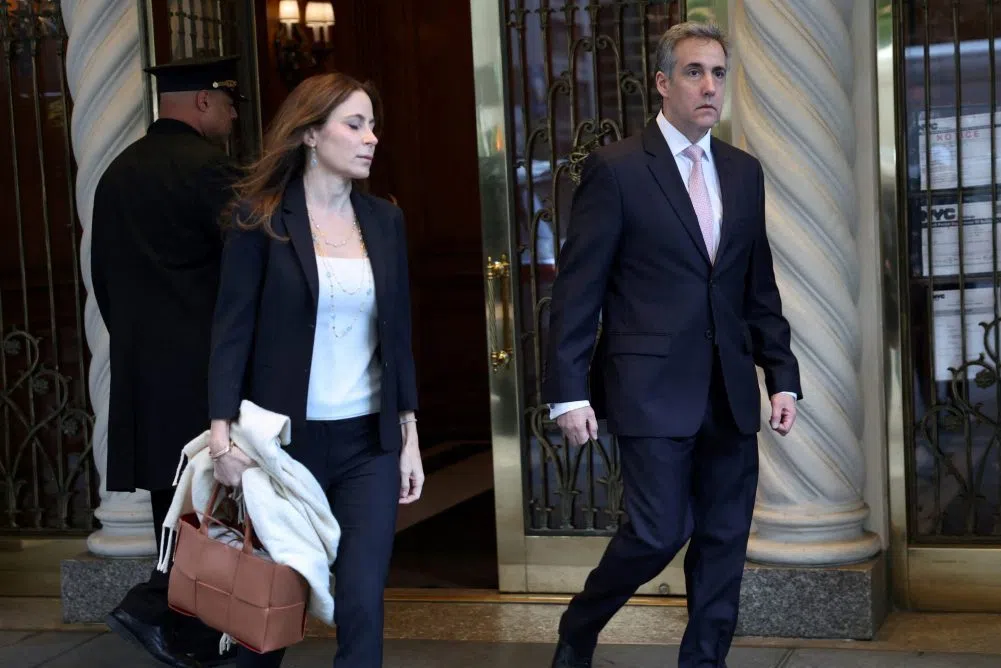
Video showed Cohen not stopping to answer journalists’ questions when he left his home early on Monday.
While the jurors will be seeing Cohen in person for the first time, his presence has loomed over the trial. Witnesses have spoken about him dozens of times, while Trump’s defense lawyers attacked his credibility from the trial’s outset, calling him an untrustworthy liar in their opening statement.
On Friday, Justice Juan Merchan urged prosecutors to tell Cohen to stop making public statements about the case after defense lawyer Todd Blanche said Cohen had posted on social media while wearing a T-shirt showing Trump behind bars.
Cohen’s $130,000 hush money payment to the porn star Stormy Daniels before the 2016 election, intended to keep her from speaking publicly about a 2006 sexual encounter she says she had with Trump, is at the center of the trial.
Prosecutors with Manhattan District Attorney Alvin Bragg’s office have accused Trump of falsely labeling his reimbursement payments to Cohen in 2017 as legal expenses in his New York-based real estate company’s books.
They say the altered business records covered up election-law and tax-law violations that elevate the 34 counts Trump faces from misdemeanors to felonies punishable by up to four years in prison.
Trump has pleaded not guilty to all 34 counts and denies having had a sexual encounter with Daniels. He argues the case is a politically motivated attempt to interfere with his campaign. Bragg, the prosecutor, is a Democrat.
“Fat Alvin, corrupt guy,” Trump said of Bragg at a New Jersey political rally on Saturday night.
Trump arrived at the courthouse on Monday with several Republican lawmakers in tow, including U.S. senators J.D. Vance and Tommy Tuberville and U.S. Representative Nicole Malliotakis.
Prosecutors say the payment to Daniels was part of an illegal scheme to influence the 2016 election by buying the silence of people with potentially damaging information. Trump’s lawyers say it was to spare him embarrassment with his family.
Cohen pleaded guilty in 2018 to violating federal campaign finance law by paying off Daniels and testified that Trump directed him to make the payment. Federal prosecutors did not charge Trump with any crime.
Trump’s defense lawyers have told the 12 jurors and six alternates that Cohen is a liar who acted on his own when paying Daniels, seeking to distance Trump from the reimbursement checks and invoices at the heart of the case.
Cohen has admitted to lying under oath multiple times, providing substantial fodder for the defense to undermine his credibility.
He has acknowledged lying to the U.S. Congress in 2017 about a Trump Organization real estate project in Moscow, but has since said he did so to protect Trump.
He also pleaded guilty to violating tax law in 2018, but now claims he did not commit that crime.
COHEN A TARGET OF TRUMP ANGER
During testimony last week jurors saw the 34 invoices, corporate ledger entries and checks that prosecutors say were falsified by Trump to obscure his reimbursement to Cohen.
A former Trump employee testified he had been told by Trump’s top financial officer that the reimbursements to Cohen were for expenses incurred during the campaign. That could undercut an argument made by Trump’s lawyers that the payments were for legal work.
However, neither that employee nor another who testified last week was able to say whether Trump himself directed the falsification of the records to hide the payment to Daniels – a hole that prosecutors will aim to fill with Cohen’s testimony.
Cohen has been on the receiving end of Trump’s vitriolic social media attacks, some of which the judge has said violated a gag order restricting Trump from making statements about witnesses, jurors and families of the judge and prosecutors if meant to interfere with the case.
Trump has called the gag order a violation of his right to free speech, and has said it is unfair to bar him from responding to attacks by witnesses such as Cohen and Daniels.
Merchan has fined Trump $10,000 for 10 violations of the order and warned the former president he could face time in jail if he keeps up his attacks.
The case is widely seen as less consequential than three other criminal prosecutions Trump faces, but it is the only one certain to go to trial before the election.
The other cases charge Trump with trying to overturn his 2020 presidential defeat and mishandling classified documents after leaving office. Trump pleaded not guilty to all three.
(Reporting by Luc Cohen in New York; Editing by Noeleen Walder and Howard Goller)
NEW YORK (Reuters) -Michael Cohen, who once said he would take a bullet for Donald Trump, was poised on Monday to serve as a star prosecution witness in the former U.S. president’s criminal trial on charges of covering up hush money paid to a porn star.
Cohen was expected to take the stand on Day 16 of the trial in New York state court in Manhattan. His testimony marks the culmination of a 15-year arc from a lawyer and fixer for the businessman-turned-politician to an outspoken antagonist.
“I’m the guy who would take a bullet for the president,” Cohen told Vanity Fair in 2017.
Two years later, facing a U.S. congressional committee, Cohen testified: “I am ashamed because I know what Mr. Trump is. He is a racist. He is a con man. He is a cheat.”
The case against Trump stems from Cohen’s $130,000 payment to porn star Stormy Daniels before the 2016 election for her silence about a sexual encounter she alleges to have had with Trump a decade earlier.
Cohen, a top executive at Trump’s real estate company before becoming his lawyer, says Trump directed the payment.
Now 57, Cohen spent more than a year in prison for crimes including a violation of federal election campaign finance laws with the payment to Daniels. In 2020 he published a book about his experience working with Trump called, “Disloyal: A Memoir.”
Trump, the Republican presidential candidate in the Nov. 5 election, has pleaded not guilty to 34 counts of falsification of business records to conceal the payment. He has also denied the encounter with Daniels, whose given name is Stephanie Clifford, and called Cohen a “serial liar.”
Cohen turned on Trump midway through his presidency, as federal investigators probed his role in the payment to Daniels and other matters.
After Trump’s own 2023 indictment, Cohen said his goal in cooperating with authorities was to “speak truth to power.”
“If speaking truth to power makes me Donald’s archnemesis, so be it,” Cohen told Reuters in a 2023 interview.
This will not be Cohen’s first time testifying in court against Trump. In a civil fraud case over the former president’s valuations of his real estate assets, Cohen said on the stand in October he had manipulated the values of Trump’s real estate properties to match “whatever number Mr. Trump told us.”
A judge in February ordered Trump to pay $454 million in penalties and interest after finding that he misled lenders and insurers about the Trump Organization’s property values. Trump is appealing.
A PRISON SENTENCE
Cohen was hired as the Trump Organization’s executive vice president and special counsel in 2007. Before that, the Long Island native and son of a Holocaust survivor worked as a malpractice lawyer and owned a fleet of yellow taxis.
He was hired after he had orchestrated the ouster of the board of directors of a condominium where he owned an apartment, which was trying to remove Trump’s name from the building’s exterior.
Cohen later advised Trump’s 2016 presidential campaign and, as his personal lawyer, remained close to Trump once he became president, though he did not have an official White House job.
In 2018, after the hush money payment to Daniels came to light, Cohen initially said he had paid with his own money and that neither the Trump campaign nor the Trump Organization reimbursed him.
He later pleaded guilty to a federal campaign finance law violation for paying Daniels and then testified in Congress that Trump told him to make the payment. He said he was reimbursed in installments and displayed a copy of a $35,000 check from Trump’s personal bank account.
Cohen was sentenced to three years in prison for the payment and other crimes, including cheating on his personal taxes and lying under oath to Congress about when the Trump Organization stopped working on a proposed building project in Russia. Cohen served more than a year before being released.
‘PART OF THE PLAYBOOK’
Relying on Cohen’s testimony presents risks for Manhattan District Attorney Alvin Bragg, given the disbarred lawyer’s history of false statements.
Cohen’s testimony at the civil fraud trial could provide fertile ground for Trump’s defense lawyers during cross-examination at the criminal trial. At the civil trial, he said he lied to the federal judge who took his guilty plea in 2018 by admitting to tax fraud – a crime he now says he did not commit.
Cohen, married with two children, has said he has taken responsibility for his wrongdoing. He has said much of his criminal conduct – including the lie to Congress and the Daniels payment – arose out of his blind loyalty to Trump.
He told Reuters in the 2023 interview he expected Trump and his allies to attack him.
“It’s all part of the playbook,” Cohen said.
(Reporting by Luc Cohen in New York; Additional reporting by Karen Freifeld; Editing by Noeleen Walder, Jonathan Oatis and Howard Goller)



Comments