UPDATED: 6:41 A.M.
PALM BEACH, Florida (Reuters) – Donald Trump was elected president, capping a remarkable comeback four years after he was voted out of the White House and ushering in a new American leadership likely to test democratic institutions at home and relations abroad.
Trump, 78, recaptured the White House on Wednesday by securing more than the 270 Electoral College votes needed to win the presidency, Edison Research projected, following a campaign of dark rhetoric that deepened the polarization in the country.
The former president’s victory in the swing state of Wisconsin pushed him over the threshold. As of 5:45 a.m. ET (1045 GMT) Trump had won 279 electoral votes to Harris’ 223 with several states yet to be counted.
He also led Harris by about 5 million votes in the popular count.
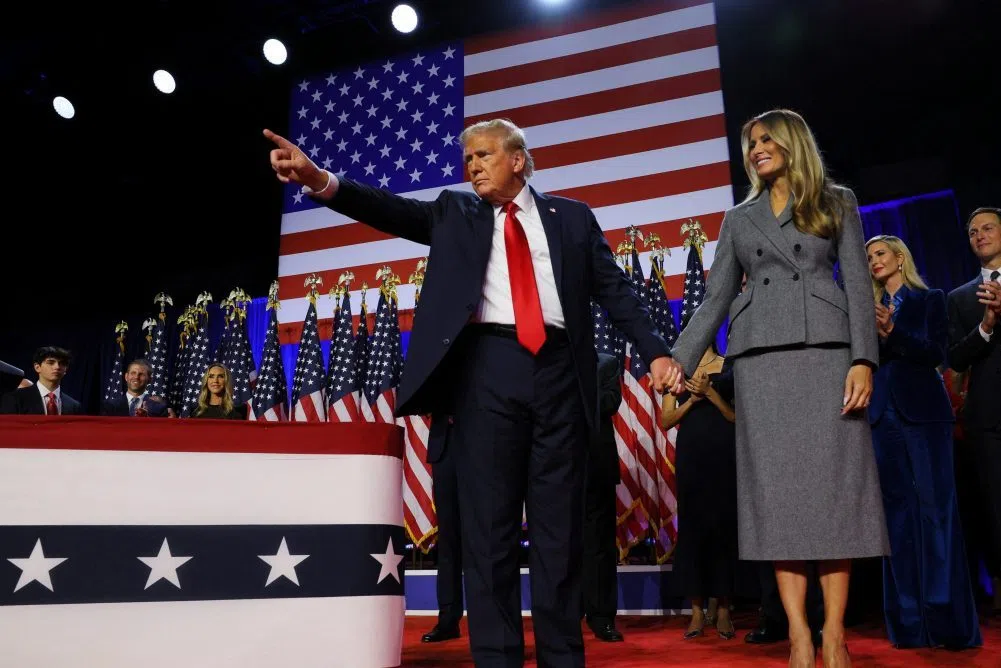
“America has given us an unprecedented and powerful mandate,” Trump said early on Wednesday to a roaring crowd of supporters at the Palm Beach County Convention Center in Florida.
Trump’s political career had appeared to be over after his false claims of election fraud led a mob of supporters to storm the U.S. Capitol on Jan. 6, 2021, in a failed bid to overturn his 2020 defeat.
But he swept away challengers inside his Republican Party and then beat Democratic candidate Kamala Harris by capitalizing on voter concerns about high prices and what Trump claimed, without evidence, was a rise in crime due to illegal immigration.
Harris did not speak to supporters who had gathered at her alma mater Howard University. Her campaign co-chair, Cedric Richmond, briefly addressed the crowd after midnight, saying Harris would speak publicly later on Wednesday.
“We still have votes to count,” he said.
Republicans won a U.S. Senate majority, but neither party appeared to have an edge in the fight for control of the House of Representatives where Republicans currently hold a narrow majority.
Major stock markets around the world rallied following Trump’s victory, and the dollar was set for its biggest one-day jump since 2020.
JOBS AND ECONOMY
Voters identified jobs and the economy as the country’s most pressing problem, according to Reuters/Ipsos opinion polls. Many Americans remained frustrated by higher prices even amid record-high stock markets, fast-growing wages and low unemployment. With the administration of President Joe Biden taking much of the blame, a majority of voters said they trusted Trump more than Harris to address the issue.
Hispanics, traditionally Democratic voters, and lower-income households hit hardest by inflation helped fuel Trump’s election victory. His loyal base of rural, white and non-college educated voters again showed up in force.
Trump prevailed despite persistently low approval ratings. Impeached twice, he has been criminally indicted four times and found civilly liable for sexual abuse and defamation. In May, Trump was convicted by a New York jury of falsifying business records to cover up hush money payments to a porn star.
His victory will have major implications for U.S. trade and climate change policies, the war in Ukraine, Americans’ taxes and immigration.
His tariff proposals could spark a fiercer trade war with China and U.S. allies, while his pledges to reduce corporate taxes and implement a spate of new cuts could balloon U.S. debt, economists say.
Trump has promised to launch a mass deportation campaign targeting immigrants in the country illegally.
He has said he wants the authority to fire civil servants he views as disloyal. His opponents fear he will turn the Justice Department and other federal law enforcement agencies into political weapons to investigate perceived enemies.
A second Trump presidency could drive a bigger wedge between Democrats and Republicans on issues such as race, gender, what and how children are taught, and reproductive rights.
HARRIS FALLS SHORT
Vice President Harris fell short in her 15-week sprint as a candidate, failing to galvanize enough support to defeat Trump, who occupied the White House from 2017-2021, or to allay voters’ concerns about the economy and immigration.
Harris had warned that Trump wanted unchecked presidential power and posed a danger to democracy.
Nearly three-quarters of voters say American democracy is under threat, according to Edison Research exit polls, underscoring the polarization in a nation where divisions have only grown starker during a fiercely competitive race.
Trump ran a campaign characterized by apocalyptic language. He called the United States a “garbage can” for immigrants, pledged to save the economy from “obliteration” and cast some rivals as the “enemy within.”
His diatribes were often aimed at migrants, who he said were “poisoning the blood of the country,” or Harris, whom he frequently derided as unintelligent.
Despite legal woes and controversies, Trump is only the second former president to win a second term after leaving the White House. The first was Grover Cleveland, who served two four-year terms starting in 1885 and 1893.
UNPRECEDENTED CAMPAIGN
Two months after Trump’s conviction in the hush money case, a would-be assassin’s bullet grazed his right ear during a July campaign rally in Pennsylvania, exacerbating fears about political violence. Another assassination attempt was thwarted in September at his Florida golf course. Trump blamed both attempts on what he claimed was the heated rhetoric of Democrats including Harris.
Barely eight days after the July shooting, Biden, 81, dropped out of the race, finally bowing to weeks of pressure from his fellow Democrats after a poor performance during his debate with Trump called into question his mental acuity and the viability of his reelection bid.
Biden’s decision to step aside turned the contest into a sprint, as Harris raced to mount her own campaign in a matter of weeks, rather than the typical months. Her rise to the top of the ticket reenergized despondent Democrats, and she raised more than $1 billion in less than three months while erasing what had been a solid Trump lead in opinion polls.
Harris’ financial advantage was partly countered by the intervention of the world’s richest man, Elon Musk, who poured more than $100 million into a super PAC mobilizing Trump voters and used his social media site X to amplify pro-Trump messaging.
As the campaign drew to a close, Harris increasingly focused on warning Americans about the perils of reelecting Trump and offered an olive branch to disaffected Republicans.
She highlighted remarks from several former Trump officials, including his former chief of staff and retired Marine Corps General John Kelly, who described Trump as a “fascist.”
Trump’s victory will broaden the fissures in American society, given his false claims of election fraud, anti-immigrant rhetoric and demonization of his political opponents, said Alan Abramowitz, a political science professor at Emory University who studies voter behavior and party politics.
A TRUMP SECOND TERM
Trump has vowed to reshape the executive branch, including firing civil servants he views as disloyal and using federal law enforcement agencies to investigate his political enemies, violating what has been a longstanding policy of keeping such agencies independent.
During his first term, Trump’s most extreme demands were sometimes stymied by his own cabinet members, most notably when Vice President Mike Pence refused to block Congress from accepting the 2020 election results.
Once the 2024 vote is certified by Congress on Jan. 6, 2025, Trump and his incoming vice president, U.S. Senator JD Vance, are due to take office on Inauguration Day, Jan. 20. Throughout his two-year-long campaign, Trump has signaled he will prioritize personal fealty in staffing his administration. He promised roles in his administration to Musk and former presidential candidate Robert F. Kennedy Jr., both avid supporters.
(Reporting by Joseph Ax, Nandita Bose and Brad Heath in Washington; Andrea Shalal in Dearborn, Michigan; Gram Slattery in Pittsburgh; Jarrett Renshaw in Philadelphia; Gabriella Borter and Alexandra Ulmer in Phoenix; Helen Coster in Raleigh, North Carolina; Stephanie Kelly in Asheville, North Carolina; Steve Holland in Palm Beach, Florida; Tim Reid, Bianca Flowers and Rich McKay in Atlanta; Brad Brooks in Las Vegas; Nathan Layne in Detroit; and Timothy Aeppel in Milwaukee; Writing by Joseph Ax and Jonathan; Allen; Editing by Ross Colvin, Colleen Jenkins, Paul Thomasch, Howard Goller and Alistair Bell)
PALM BEACH, Florida (Reuters) -Republican Donald Trump claimed victory in the 2024 presidential contest after Fox News projected that he had defeated Democrat Kamala Harris, which would cap a stunning political comeback four years after he left the White House.
“America has given us an unprecedented and powerful mandate,” he said early on Wednesday to a roaring crowd of supporters at the Palm Beach County Convention Center, flanked by his vice presidential running mate, Senator JD Vance, Republican leaders and members of Trump’s family.
He also spent several minutes praising Elon Musk, the richest man in the world, who pumped some $120 million into backing Trump’s campaign. Trump has said he will appoint Musk to lead a government efficiency commission.
Other news outlets had yet to call the race for Trump, but he appeared on the verge of winning after capturing the battleground states of Pennsylvania, North Carolina and Georgia and holding leads in the other four, according to Edison Research.
Harris did not speak to her supporters, who had gathered at her alma mater Howard University. Her campaign co-chair, Cedric Richmond, briefly addressed the crowd after midnight, saying Harris would speak publicly on Wednesday.
“We still have votes to count,” he said.
The former president was showing strength across broad swaths of the country, improving on his 2020 performance everywhere from rural areas to urban centers.
Republicans won a U.S. Senate majority after flipping Democratic seats in West Virginia and Ohio. Neither party appeared to have an edge in the fight for control of the House of Representatives where Republicans currently hold a narrow majority.
Trump went into Election Day with a 50-50 chance of reclaiming the White House, a remarkable turnaround from Jan. 6, 2021, when many pundits pronounced his political career to be over. That day, a mob of his supporters stormed Congress in a violent attempt to overturn the results of the 2020 election.
Trump picked up more support from Hispanics, traditionally Democratic voters, and among lower-income households that have keenly felt the sting of price rises since the last presidential election in 2020, according to exit polls from Edison.
Trump won 45% of Hispanic voters nationwide, trailing Harris with 53% but up 13 percentage points from 2020.
About 31% of voters said the economy was their top issue, and they voted for Trump by a 79%-to-20% margin, according to exit polls. Some 45% of voters across the country said their family’s financial situation was worse off today than four years ago, and they favored Trump 80% to 17%.
Global investors were increasingly pricing in a Trump win late on Tuesday. U.S. stock futures and the dollar pushed higher, while Treasury yields climbed and bitcoin rose – all flagged by analysts and investors as trades that favor a Trump victory.
No matter who won the election, history was in the making. Trump, 78, the only president to be impeached twice and the first former president to be criminally convicted, would also become the first president to win non-consecutive terms in more than a century and would be the oldest presidential candidate ever elected.
If elected, Harris, 60, the first female vice president, would become the first woman, Black woman and South Asian American to win the presidency.
TRUMP OUTPERFORMS 2020
Trump was earning a bigger share of the vote than he did four years ago in nearly every corner of the country.
By 12:30 a.m. ET, officials had nearly completed their count of ballots in more than 1,600 counties – about half the country – and Trump’s share was up about 2 percentage points compared to 2020, reflecting a broad if not especially deep shift in Americans’ support for the president they ousted four years ago.
He improved his numbers in suburban counties, rural regions and even some large cities that are historically bastions of Democratic support; in high-income counties and low-income ones; and in places where unemployment was comparatively high and in places where it is now at record lows.
Harris had banked on big margins among urban and suburban voters, but her support in those places was running well behind President Joe Biden’s in the 2020 election.
Nearly three-quarters of voters said American democracy is under threat, according to the exit polls, underscoring the depth of polarization in a nation where divisions have only grown starker during a fiercely competitive race.
Trump employed increasingly apocalyptic rhetoric while stoking unfounded fears that the election system cannot be trusted. Harris warned that a second Trump term would threaten the underpinnings of American democracy.
Hours before polls closed, Trump claimed on his Truth Social site without evidence that there was “a lot of talk about massive CHEATING” in Philadelphia, echoing his false claims in 2020 that fraud had occurred in large, Democratic-dominated cities. In a subsequent post, he also asserted there was fraud in Detroit.
“I don’t respond to nonsense,” Detroit City Clerk Janice Winfrey told Reuters.
A Philadelphia city commissioner, Seth Bluestein, replied on X, “There is absolutely no truth to this allegation.”
Trump voted earlier near his home in Palm Beach, Florida.
“If I lose an election, if it’s a fair election, I’m gonna be the first one to acknowledge it,” Trump told reporters.
Millions of Americans waited in orderly lines to cast ballots, with only sporadic disruptions reported across a handful of states, including several non-credible bomb threats that the FBI said appeared to originate from Russian email domains.
Tuesday’s vote capped a dizzying race churned by unprecedented events, including two assassination attempts against Trump, Biden’s surprise withdrawal and Harris’ rapid rise.
(Reporting by Joseph Ax, Nandita Bose and Brad Heath in Washington; Andrea Shalal in Dearborn, Michigan; Gram Slattery in Pittsburgh; Jarrett Renshaw in Philadelphia; Gabriella Borter and Alexandra Ulmer in Phoenix; Helen Coster in Raleigh, North Carolina; Stephanie Kelly in Asheville, North Carolina; Steve Holland in Palm Beach, Florida; Tim Reid, Bianca Flowers and Rich McKay in Atlanta; Brad Brooks in Las Vegas; Nathan Layne in Detroit; and Timothy Aeppel in Milwaukee; Writing by Joseph Ax and Jonathan Allen; Editing by Ross Colvin, Colleen Jenkins and Howard Goller)




Comments